
Sabrina Gonzalez Pasterski and the quiet revolution in theoretical physics
 supriyatunk
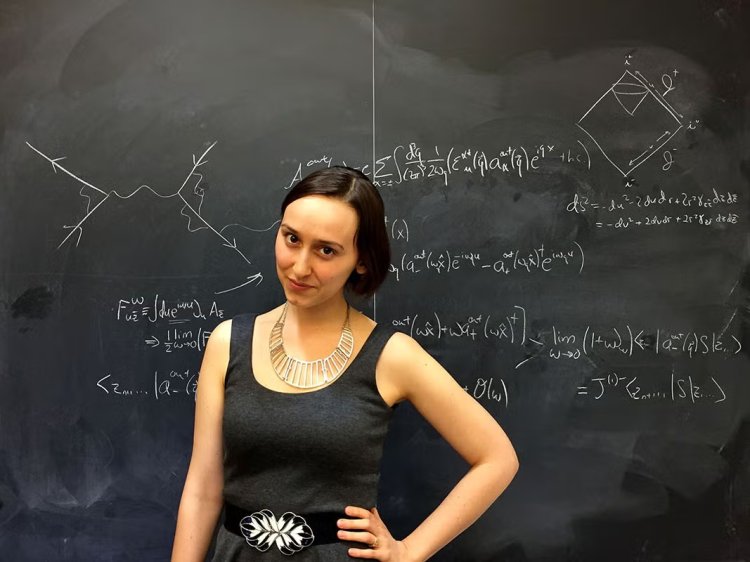
In an era when scientific breakthroughs are often packaged for viral attention, Sabrina Gonzalez Pasterski stands apart. Brilliant, intensely private, and deeply committed to fundamental research, the Cuban-American theoretical physicist has earned global respect not through spectacle, but through substance.
Born in 1993 to a first-generation immigrant family in the United States, Pasterski displayed an uncommon blend of curiosity and engineering skill from an early age. At just 14, she built a single-engine aircraft from a kit in her father’s garage. Two years later, she became the youngest known person to fly an airplane she had constructed herself, a feat that hinted at a mind equally comfortable with theory and hands-on precision.
Her academic rise was just as remarkable. Pasterski entered the Massachusetts Institute of Technology and completed her undergraduate degree in physics in only three years, graduating in 2013 with a perfect 5.0 GPA. She became the first woman in nearly two decades to finish at the top of MIT’s physics department, a milestone that quietly reshaped expectations in one of the world’s most demanding scientific environments.
From MIT, she moved to Harvard University, earning her PhD in high-energy theoretical physics under the mentorship of renowned physicist Andrew Strominger. Her research explores some of the most profound and unresolved questions in modern science: quantum gravity, black holes, gravitational memory, and celestial holography, a framework that seeks to reconcile gravity with quantum mechanics by mapping information at the edges of spacetime.
Pasterski’s work has not gone unnoticed. Her papers have been cited by leading figures in physics, including Stephen Hawking in his final research, placing her contributions within the lineage of ideas that attempt to extend and challenge Einstein’s legacy. While media outlets have occasionally labeled her the “Next Einstein,” colleagues emphasize that her real distinction lies in the originality and mathematical rigor of her thinking, rather than in grand comparisons.
After postdoctoral work at Princeton University, Pasterski joined the Perimeter Institute for Theoretical Physics, where she continues her research while also serving as a visiting scholar at the Institute for Advanced Study in Princeton. Notably, she has declined high-profile offers from organizations such as NASA and private aerospace companies, choosing instead to focus on foundational science rather than applied or commercial work.
Equally striking is her deliberate distance from public life. Pasterski maintains no social media presence and rarely gives interviews. Her work is shared primarily through academic publications and her minimalist personal website, reflecting a philosophy that places ideas above visibility. In a scientific culture increasingly shaped by branding and outreach, her approach feels almost radical.
As of early 2026, Sabrina Gonzalez Pasterski remains one of the most influential young thinkers in theoretical physics, not because she seeks recognition, but because her ideas continue to push the boundaries of how we understand space, time, and the universe itself. In doing so, she represents a quieter, deeper kind of scientific revolution, one built on patience, precision, and an unwavering commitment to truth.