
Why Desert Nations Like Saudi Arabia and the UAE Still Rely on Imported Sand
 Ashwini Gambo
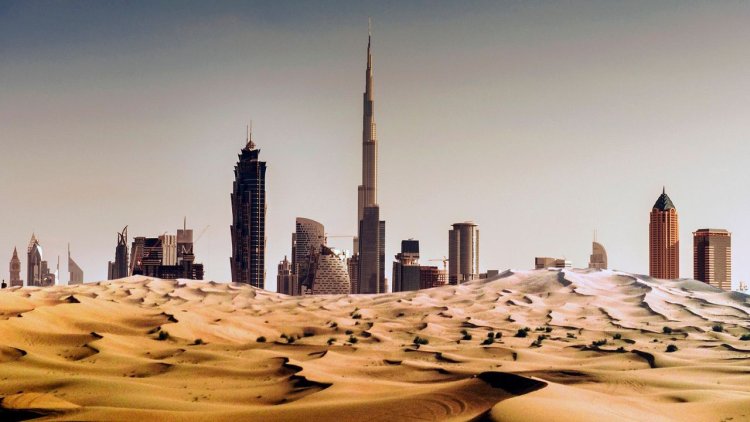
At first glance, it sounds absurd. Why would countries defined by vast deserts import sand from places like Australia, China or Belgium? Yet Saudi Arabia and the UAE do exactly that and at scale. The explanation lies not in scarcity, but in science, engineering and construction standards.
As both countries push ahead with mega-projects from the UAE’s skyline-defining towers to Saudi Arabia’s Vision 2030 developments the demand is not for just any sand, but for a specific type of construction-grade material that desert environments cannot provide.
This paradox highlights a broader and growing global issue: the shortage of high-quality sand suitable for modern infrastructure.
Why desert sand won’t work-
Despite its abundance, desert sand is unsuitable for concrete. Over thousands of years, wind erosion smooths desert sand grains, making them round and slippery. These grains fail to interlock properly, weakening the structural integrity of concrete.
Concrete relies on three core ingredients: cement, water and aggregate. Aggregate made up of gravel and sand accounts for up to 80 per cent of concrete’s volume. The sand component must be angular and coarse to bind effectively with cement.
Desert sand behaves more like marbles than building blocks. As journalist Vince Beiser notes in The World in a Grain, making concrete with desert sand is like “trying to build something out of a stack of marbles instead of little bricks.”
Construction-grade sand is typically sourced from riverbeds, lakes and seabeds, where water erosion creates sharp-edged grains capable of forming strong bonds. According to the UN Environment Programme (UNEP), while the world consumes roughly 50 billion tonnes of sand annually, only a fraction meets construction standards.
Australia’s role in supplying sand-
Australia has emerged as a key exporter of high-quality silica and construction sand. Data from the Observatory of Economic Complexity (OEC) shows that in 2023, Australia exported $273 million worth of sand, ranking it the world’s second-largest exporter.
Saudi Arabia was among the importers, purchasing around $140,000 worth of Australian construction-grade sand that year. While modest in value, the imports underscore a critical dependency: mega-projects demand materials that desert sand cannot provide.
The issue resurfaced in public discourse in 2024 as Saudi Arabia accelerated work on projects such as NEOM, The Red Sea Project and Qiddiya, all of which require concrete meeting the highest international standards.
A regional paradox across the Gulf-
Saudi Arabia is not alone. The UAE and Qatar face the same challenge. Despite vast deserts, Gulf states have long relied on imported sand for high-spec construction.
Dubai’s most famous structure, the Burj Khalifa, required 330 million litres of concrete, along with tens of thousands of tonnes of steel and glass. Desert sand was unusable. Instead, builders sourced suitable sand from overseas, including Australia.
Sand in the UAE is also critical beyond skyscrapers. It is used in glass manufacturing, artificial islands like Palm Jumeirah, and large-scale beach nourishment projects. The Palm Jumeirah alone consumed 186.5 million cubic metres of marine sand, exhausting nearby reserves.
A 2024 UNEP policy brief notes that rapid urbanisation in the Middle East continues to drive global demand for construction sand, reinforcing reliance on imports despite regional abundance.
Vision 2030 and the demand for quality-
Saudi Arabia’s Vision 2030 strategy aims to diversify the economy beyond oil through infrastructure, tourism and smart-city developments. Projects such as The Line and NEOM require materials that meet precise engineering specifications.
In this context, importing industrial-grade sand is not a luxury it is a necessity. Without it, projects would face either structural risks or costly delays.
A global sand crisis-
The Gulf’s reliance on imported sand reflects a deeper global challenge. UNEP has warned of a growing “sand crisis”, driven by unregulated extraction that causes river erosion, habitat loss and biodiversity damage.
To address this, countries are exploring alternatives such as manufactured sand (M-sand), produced by crushing rock, and recycled construction waste. Saudi Arabia is also investigating these solutions, though no comprehensive national policy has yet emerged to curb imports.
Over time, advances in materials science and sustainable construction may reduce dependence on natural sand. Until then, even the world’s most sand-rich nations will continue importing the one type they lack the kind that actually holds cities together.